Tactile measurement and coordination technology for precise results

Bharat Forge Daun stands for the highest precision in metrology. Using state-of-the-art CNC systems and coordinate measuring machines, we measure the shape, position and surfaces of components in the sub-micrometer range. Our tactile measuring technology with sensitive probes provides reliable measurement data for quality assurance and series measurements.

Dimensionally accurate measurement of complex shapes and components
Consistent accuracy for individual parts, prototypes and series
Efficient processes with high-performance measuring systems

What is tactile measurement technology?

Tactile measurement is a precise measuring method in which components are accurately measured using modern coordinate measuring machines and tactile sensors. The measuring tasks are automated and enable fast, repeatable data acquisition.

Shape, dimensions, surfaces and material thickness are recorded. Mechanical probing of the object surface with highly sensitive probes produces precise measurement data as a basis for analysis, testing, optimization and quality assurance.

Compared to optical 3D measurement technology, it is considered more traditional, but remains indispensable for high accuracy requirements and complex geometries. At Bharat Forge Daun, it complements CNC machining processes for maximum process reliability.

What possibilities does tactile measurement technology offer?

Tactile measurement technology enables the high-precision measurement of complex components, shapes and surfaces. With modern coordinate measuring machines and sensitive probes, dimensions, position tolerances and shape deviations are precisely recorded – even with challenging materials such as steel or aluminum.

It is ideal for inspecting workpieces, assemblies and devices after CNC turning, milling, welding, engraving or polishing. This ensures that every part meets the required tolerances and quality standards.

Tactile measurement provides reliable measurement data for analyses, process optimization and consistent quality assurance in mechanical engineering, the automotive industry and other manufacturing sectors.

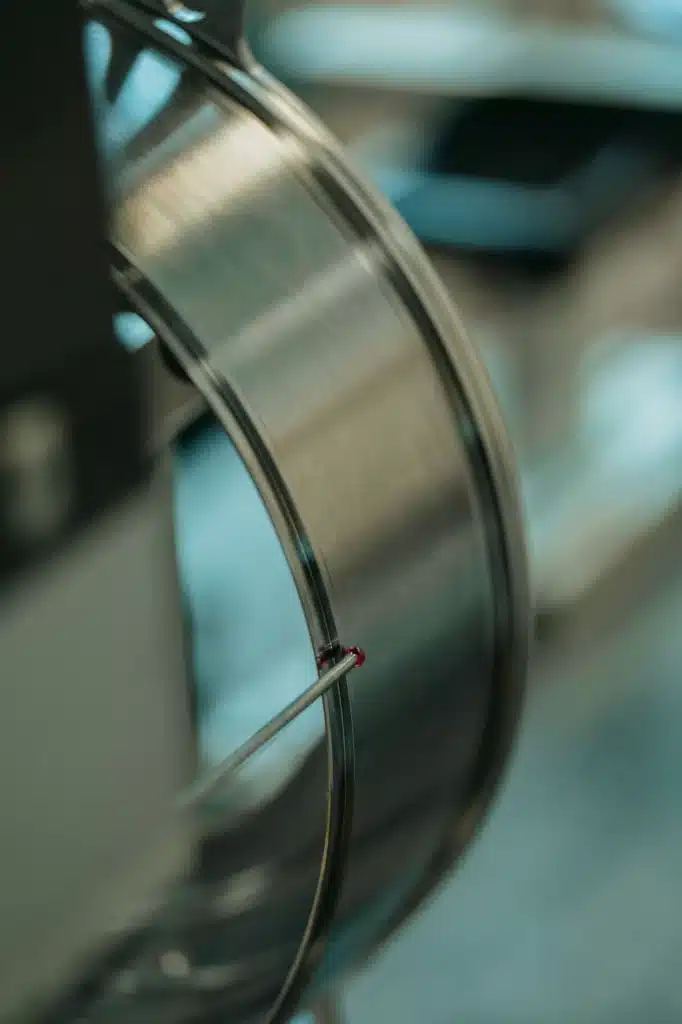
A close-up of a metallic spool or coil, with a thin, red-tipped wire being guided along its edge. The background is blurred, drawing focus to the shiny surface and the detail of the wire.

What is CNC measurement with 3D measuring machine and optical 3D measurement technology?

CNC measurement is a precise measuring process in which components are accurately recorded using modern 3D coordinate measuring machines and optical sensors. The measuring tasks run automatically via CNC programs and enable fast, repeatable data acquisition.

Shape, dimensions, surfaces and material thickness are recorded. Optical 3D measurement technology, photogrammetry, fringe projection and laser scanning are used to create precise 3D data as a basis for analysis, testing, optimization and quality assurance.

CNC measurement provides a complete overview of each component and supports production through high dimensional accuracy and process reliability. It is used in particular in the automotive industry, in mechanical engineering and in plant construction.
At Bharat Forge Daun, CNC measurement is an integral part of our measurement technology and combines state-of-the-art technologies with many years of expertise.

What possibilities does CNC measurement with 3D measuring systems offer?

Our CNC measuring machines and 3D measuring systems are specially designed for the precise measurement of components made of steel, aluminum and other materials. Automated programs, optical 3D measurement technology such as fringe projection and laser scanning as well as the use of state-of-the-art measuring devices and 3D scanners enable us to capture even complex geometries with the highest dimensional accuracy.

Thanks to stable processes, we achieve tight tolerances, exact dimensions and consistent accuracy – regardless of whether we are dealing with individual parts, prototypes or series.

With this technological foundation, CNC measurement is a central component of our 3D measurement technology and offers customers in a wide range of industries practical applications – from precise analyses and inspections to digital evaluations in mechanical engineering and the automotive industry.

What are the advantages of tactile measurement with a coordinate measuring machine?

We use state-of-the-art coordinate measuring machines and precise tactile measuring technology to measure components reliably and efficiently. Whether single part, prototype or series - we guarantee exact measurement results, constant accuracy and fast processes in all projects.

What steps does tactile measurement involve?

A white icon of a book with a command prompt arrow (greater than symbol and hyphen) on the cover, on a light gray background.

Step 1 - Data and programming

The measuring probe scans the surface point by point. The measurement data obtained is digitally evaluated and documented for analysis, testing and quality assurance. This results in a complete, traceable assessment of the dimensional accuracy of each component.
A white cube with three visible faces is surrounded by two circular arrows, forming a continuous loop, on a light gray background.

Step 2 - Preparing the measurement

The workpiece is fixed on the coordinate measuring machine. Depending on the material, size and geometry, suitable probes and measuring strategies are selected – e.g. for components from CNC turning, milling or welding processes.
A white check mark inside a white circle on a light gray background.

Step 3 - Measurement and quality control

The measuring probe scans the surface point by point. The measurement data obtained is digitally evaluated and documented for analysis, testing and quality assurance. This results in a complete, traceable assessment of the dimensional accuracy of each component.

Why tactile measurement technology at Bharat Forge Daun?

At Bharat Forge Daun, you receive precise measurement results that combine accuracy, stability and reliability. Our many years of experience in tactile measurement technology and the use of state-of-the-art coordinate measuring machines make us a strong partner for demanding components and manufacturing processes.

We combine precise measuring systems with efficient data evaluation and tested quality. This produces measurement results that are reliable, on time and reproducible, even with complex geometries, tight tolerances and high requirements – from CNC turned and milled parts to welded assemblies and polished components.

A close-up of a precision measurement tool inspecting a shiny, metallic cylindrical component on a machine, with parts of the equipment visible in the foreground.

Why CNC turning with us

Bharat Forge Daun GmbH stands for excellence and cutting-edge technology in metal processing. With our many years of experience, high vertical range of manufacture and modern machinery, we are your reliable partner for demanding machining projects.

Our processes are designed for precision, repeat accuracy and adherence to deadlines – even for complex components, tight tolerances and large quantities. Thanks to the close integration of toolmaking, fixture construction and mechanical processing, we offer CNC turning with consistent quality from a single source.

Advantages at a glance:

  • High process stability and tested quality
  • Precise production of complex geometries
  • Efficient processes and short throughput times

Challenging projects with tactile measurement technology?

We measure complex components precisely, on time and with consistent quality - from individual parts to series production.

Our CNC lathes and machining options

For CNC turning, we rely on robust CNC lathes from FMS and Heyligenstaedt. We use them to manufacture large, rotationally symmetrical workpieces precisely and economically – from individual parts to series production. The machines are designed for CNC machining of long components with large diameters and their stable construction enables a reliable, reproducible production process. One of the lathes is also equipped with an Ecoroll unit for surface smoothing, which further improves component quality.

Frequently asked questions about tactile measurement

How does the tactile system work?

The tactile system works with a measuring probe that touches the surface of a component point by point. Coordinates, shape and dimensions are precisely recorded and digitally evaluated as measurement data. In conjunction with CNC milling, turning or welding, this method ensures maximum dimensional accuracy and quality assurance – especially for complex workpieces where optical 3D measurement technology reaches its limits.

What are tactile sensors?

Tactile sensors are precise probes that detect minimal changes in position when touching a workpiece. They are used to accurately determine surfaces, position tolerances and geometries. In combination with modern coordinate measuring machines, they provide reliable measurement data for processes such as CNC milling, assembly of components or polishing, where maximum accuracy is required.

What measurement methods are available?

In metrology, tactile, optical and combined measuring methods are primarily used. While tactile metrology works by touch and offers maximum precision, optical 3D metrology enables fast, area-based measurement. Depending on the component, material and requirements, both methods are used in addition – for example for CNC-milled, welded or engraved components.